
What to Do in the First 10 Minutes of a Burst Pipe
If you’re standing over a puddle right now with your heart racing, take a breath. You don’t need a wrench or a lick of plumbing know-how to get through the next ten minutes safely, and you don’t need to figure it out alone while the water keeps spreading. You just need to know what to do first.
Step One: Find and Shut Off Your Main Water Valve
Nothing else matters until the water stops moving, so let’s start there before worrying about anything else. Even the EPA points to how much a fast homeowner response limits water damage, and a burst pipe raises those stakes even further, since there’s no slow drip to work with here, only an open line.
How to Locate and Close the Main Valve
Preferably, you know where to find your valve before you’re standing in an inch of water. If you don’t, that’s okay; most homes tuck the main shutoff valve into one of a handful of predictable spots. Start with whichever spot matches your specific house setup.
- Basements and crawlspaces: Look where the water line enters the house, usually along an exterior wall.
- Homes without a basement: Check near the water heater or in a utility closet.
- Homes on well systems: Look near the pressure tank instead of a street-side connection.
- Outdoor access: A street-side valve near the curb may also work, though it often requires a special key.
Once you’ve found it, it’s time to employ that generational human knowledge. Righty tighty, lefty loosey. Turn your valve clockwise until you can’t tighten it anymore. A gate valve might take several full turns to close, while a ball valve only needs a quarter.
How to Confirm the Water Has Fully Stopped
Give it a minute or two, then check any faucet in the house. If water’s still trickling out, then the valve hasn’t seated fully, or there’s a second source feeding the line. Before you move on, return to your valve and double-check it’s turned as far as it’ll go.
How to Check for a Second Source
Don’t assume the valve failed if the trickle doesn’t stop right away. Larger homes and homes with irrigation systems sometimes have more than one place water can enter the line. Check whether a dedicated irrigation system has its own shutoff near the meter or in a utility area. It’s worth a look if an outdoor spigot or the sprinklers could be feeding water into the line.
If you track down a second source and it has its own shutoff, close that too. If you can’t find one, stop troubleshooting there. Let a plumber sort out where the water is still coming from.
Step Two: Check for Electrical Danger Before You Go Further
Water and electricity together are a real hazard, no question. This is the one spot where slowing down matters more than moving fast. A wrong call here carries more risk than anywhere else on this list.
Don’t walk through standing water to reach the main shutoff, another plumbing valve, or the breaker panel. If there’s any chance that water could be energized, stay out of it entirely. Water damage can be repaired. Getting hurt can’t. It takes surprisingly little electrical current to injure someone. That’s why even a standard household circuit deserves real caution around standing water.
How to Spot Other Electrical Hazards on the Floor
An extension cord or power strip sitting in even a small amount of water can be just as dangerous as one that’s fully submerged, so there’s no safe water depth to watch for. Don’t assume a normal 120-volt household circuit is harmless just because it isn’t labeled high voltage. Ordinary household current is more than enough to cause serious injury. Water doesn’t even need to reach a wall outlet for a hazard to exist. Look for equipment that’s already sitting on or near the floor:
- Extension cords
- Power strips
- Plug connections
- Sump pumps
- Dehumidifiers
- Portable air conditioners
- Refrigerators or freezers
- Appliance cords
- Floor outlets
- Any other electrical equipment
If any of these are sitting in standing water, treat that area the way you’d treat a wet breaker panel. Stay back, and don’t touch it.
How to Judge Whether the Power Is Safe to Cut Yourself
If your breaker panel is dry, well above the waterline, and reachable without standing in water or passing any of the hazards above, flip off the switch for that area. Only do this if you’re standing on dry ground, and use your hand only, nothing wet, nothing metal.
How to Tell When You Should Stay Back and Call the Utility Instead
Since water conducts electricity, note whether getting to that panel means wading through water or the panel itself looks wet, and if it does, don’t chance it. Call your electric utility instead, and have them cut power at the meter to keep you clear of the water.
Step Three: Photograph and Record the Damage
Once the water’s under control and the electrical risk is handled, take a breath and grab your phone. This next step doesn’t take long, and it can make a real difference once the claims process starts.
Document Everything Before Disturbing the Scene
Standard homeowners policies typically cover water damage from a burst pipe when it’s sudden and unexpected, but the claim rides heavily on your documentation. Blurry photos taken after cleanup starts won’t carry the same weight as a clear, timestamped record from before anything moved. Hang onto the original photo and video files rather than screenshots, since these preserve date and time information.
What Should You Document Specifically?
Work through the space methodically before you touch anything, and be specific rather than general.
- The break itself, in close-up, if you can see it without disturbing anything around it
- Wide shots of every affected room, showing how far the water traveled and how deep it’s pooled
- Damaged flooring, drywall, baseboards, and ceilings, especially any bowing, staining, or separation
- Furniture, rugs, and electronics caught in the water’s path, including model or serial numbers on anything electronic
- A short video walkthrough of the space, since video captures the scope faster than photos alone
- The exact time you noticed the problem and the time you shut off the main valve
Keep any receipts for towels, a wet vac rental, or anything else you buy to control the damage tonight. Many policies include some coverage for reasonable mitigation costs like these, so it’s worth holding onto the receipts either way. Future you, filling out a claim form tonight, will thank present you for those extra minutes with the camera.
Step Four: Contain the Water and Protect What You Can
With the source shut off and the scene documented, there’s one job left before the plumber shows up, and that’s keeping the water from spreading any further while protecting whatever’s still sitting in its path.
How to Slow the Spread With Towels and Buckets
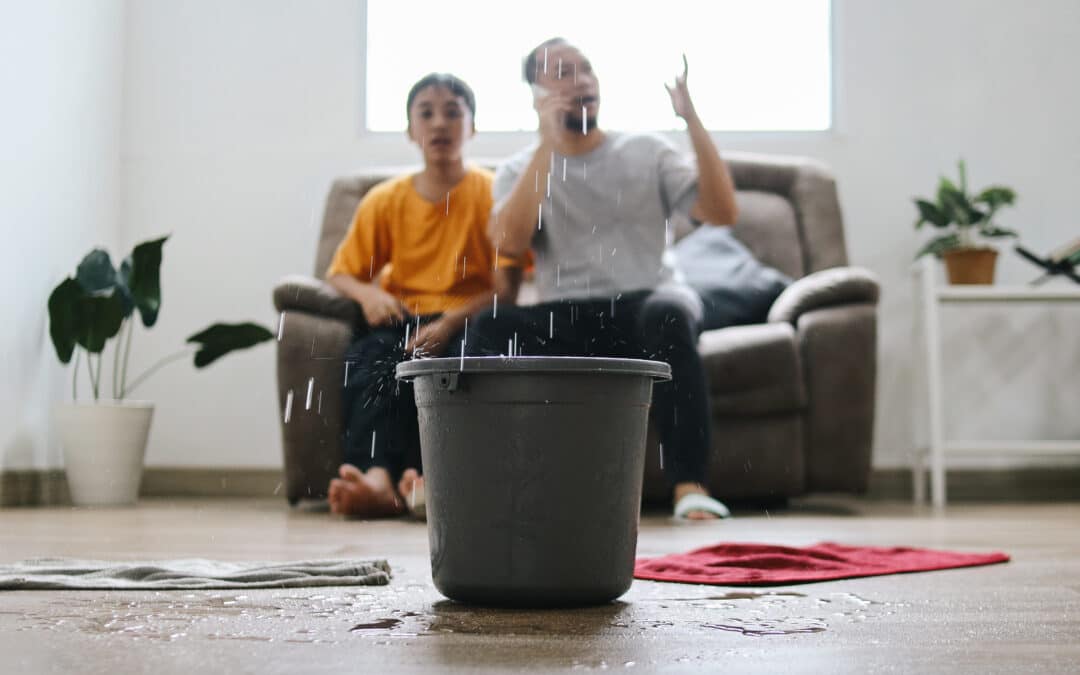
Grab towels, buckets, anything waterproof you’ve got, and catch the active dripping while soaking up what’s already pooled. Move rugs, electronics, and anything you’d hate to lose out of the water’s path instead of letting it soak. If the water’s heading toward an exterior door or a floor drain, let it go there since gravity is doing the work for you.
How to Know You Have Done All You Safely Can
There’s a point where containment stops being useful and starts being risky, especially around wet electrical outlets, sagging ceilings, or standing water deep enough to hide hazards underneath. Once you’ve slowed the spread and protected what you reasonably can, stop there.
You’ve done your part. From here, the pipe repair itself is a job for a licensed plumber, not something to tackle alone.
Last Step: Call a Plumber
Most people never think about their shutoff valve until a day exactly like today, and that’s normal. What matters now is that yours is off, the scene is documented, and the immediate danger is behind you. The hard part’s done.
The next call matters just as much as the first ten minutes did. A burst pipe can come from age, a hard freeze, corrosion, or pressure problems elsewhere in the system, and figuring out which one it is takes an on-site look rather than a guess over the phone.
Mold is the other reason this isn’t something to put off. Wet materials can start supporting growth in as little as a day or two. Once the danger has passed, don’t wait to reach out for emergency plumbing help.
Talk to a Local Plumbing Professional and get someone from PlumBubble Plumbing Services on the way while there’s still time to prevent secondary damage.